Story by Sarah Salmons
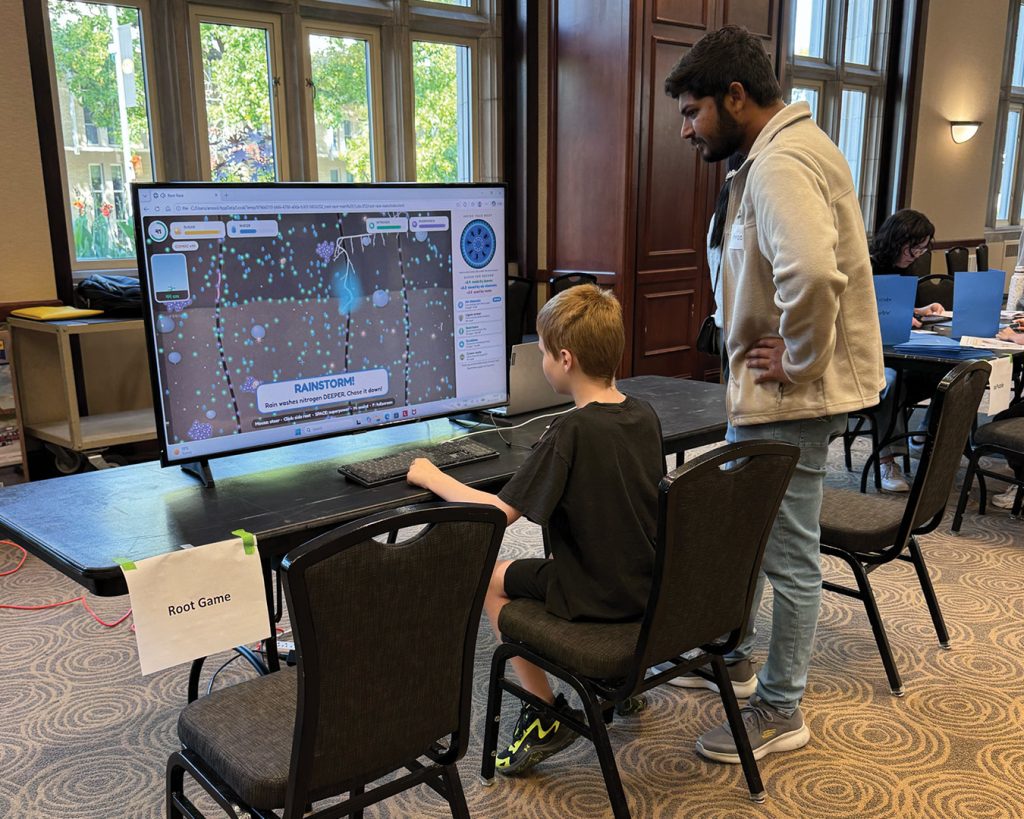
What happens when you put a microscope in front of a curious elementary student, give them the opportunity to investigate a seed or let them step inside a real research laboratory?
For more than 50 families who attended Mizzou’s Junior Plant Scientists Day, the answer was an opportunity to discover the fascinating world of plant science.
The event, along with a complementary Plant Science Discovery Lab for middle and high school students, brought together the University of Missouri’s College of Agriculture, Food and Natural Resources (CAFNR) and College of Education & Human Development (CEHD) to make university research accessible to young learners and their families.
The two hands-on outreach programs were part of a $1 million National Science Foundation (NSF)-funded research project led by Soyon Park, assistant professor of plant science and technology in CAFNR. Through the collaboration, Mizzou researchers and educators extended the project’s impact beyond the laboratory, creating opportunities for K-12 students to explore science through direct experience.
Junior Plant Scientists Day introduced elementary-aged students and their families to plant science through interactive, station-based activities. Participants explored topics such as seeds, pollination, flowers, plant structures and plant growth, learning through observation, experimentation and discovery.
More than 50 families participated, moving through activities designed to encourage questions, spark curiosity and help children understand the science behind the plants they encounter every day.
Middle and high school students had the opportunity to step into an active research environment and explore plant science through hands-on laboratory investigations.
Students teaching students
Undergraduate and graduate students from both CAFNR and CEHD collaborated to design and develop the station activities, working with Park and Yeji Kim, assistant professor in CEHD’s Department of Learning, Teaching and Curriculum.
The experience gave Mizzou students an opportunity to translate their academic knowledge into engaging, age-appropriate learning experiences. They also gained practical experience in science communication, educational outreach and community engagement.
Kim said the collaboration reflects the value of connecting disciplines that might not always intersect in traditional classroom or research settings.
By bringing together expertise in plant science and education, the team created learning experiences that made complex scientific concepts approachable for young audiences while giving Mizzou students meaningful opportunities to share their knowledge with the community.
Connecting research with real-world impact
The outreach events are part of a broader NSF-funded project led by Park that is exploring a novel approach to plant genome editing.
Park and her research team are investigating whether parasitic plants can be used to deliver genes into host plants, potentially creating a new way to modify plant genomes. The approach could eventually help scientists address challenges in transforming economically important crops such as soybeans and maize, which can be difficult and time-consuming to genetically transform.
Through the partnership with Kim and CEHD, the team expanded its original outreach concept, which focused on refugee students from local high schools, into a broader community-based initiative serving K–12 students and families.
The result was an opportunity to connect university research with learners across age groups while introducing them to the people and discoveries that drive scientific progress.
By bringing young learners into the world of scientific discovery, Park, Kim and their teams are helping cultivate their curiosity and spark interest in plant science.