Fulbright scholar Sam von Gillern to advance global learning and AI literacy
Story by Sarah Salmons
Photo by Morgan Solomon
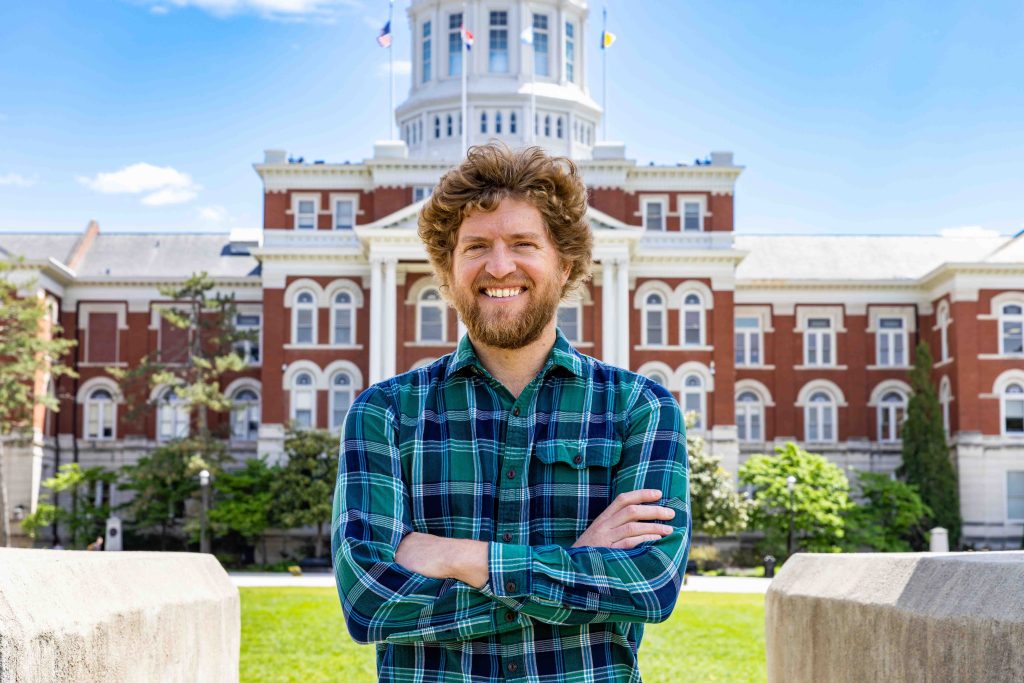
Dr. Sam von Gillern, an assistant professor of literacy education in the Department of Learning, Teaching and Curriculum for the College of Education & Human Development, has been selected for the highly competitive Fulbright U.S. Scholar Program, earning an opportunity to spend four months at Pontificia Universidad Católica de Chile and the National Center for Artificial Intelligence (CENIA) in Santiago.
He will collaborate with researchers and educators to explore how artificial intelligence can support teaching and learning in ways that are ethical, practical and beneficial for students.
For von Gillern, whose work focuses on AI literacy, digital literacies and teacher education, the award represents both a professional milestone and a meaningful opportunity.
“This Fulbright opportunity is deeply meaningful to me,” von Gillern said. “Personally, it brings together several parts of my life that I care about: education, language, family and cross-cultural connection.”
The experience also continues a lifelong interest in international learning. Although he has previously spent time in Latin America and has strong personal ties to the region through his family, this will be his first extended opportunity to live and work in Chile.
“It’s a significant honor for me to have the opportunity to live and work in Chile, build relationships and contribute to shared educational goals,” he said.
Artificial Intelligence is rapidly transforming education, creating both opportunities and challenges for teachers worldwide. Through his Fulbright project, von Gillern will work alongside Chilean educators and researchers to better understand how AI can be integrated into classrooms while maintaining a focus on student learning, critical thinking and ethical use.
Rather than approaching the experience as an expert bringing answers, von Gillern sees it as an opportunity for mutual learning.
“The goal is not simply to bring ideas from the United States to Chile,” he said. “It is to learn together, listen carefully and build educational approaches that reflect local knowledge, cultural strengths and shared hopes for students’ futures.”
His work will focus in part on rural education, where schools often face unique challenges in accessing emerging technologies and professional development opportunities. von Gillern believes AI has the potential to expand educational opportunities when implemented thoughtfully and equitably.
“I am especially excited that this project focuses on rural educators because rural schools are full of talented teachers and students, yet they often have fewer opportunities to access emerging technologies and professional learning,” he said.
While von Gillern will contribute his expertise in AI literacy and teacher education, he expects some of the most meaningful lessons to come from the educators and students he meets.
He is particularly interested in understanding how Chilean teachers are navigating AI in classrooms shaped by multilingual learners, varying levels of technology access and diverse community needs.
“These educators bring creativity, flexibility and deep knowledge of their students,” von Gillern said. “I expect their perspectives will challenge and strengthen my own thinking about AI literacy.”
He is equally eager to hear directly from students about how technology is influencing the ways they learn, communicate and engage with the world around them.
“Young people are growing up in a world where AI will shape how they read, write, communicate, work and participate in society,” he said. “Listening to students and teachers in Chile will help me better understand how AI literacy can be taught in ways that are meaningful across different cultural contexts.”
The Fulbright Program, the U.S. government’s flagship international educational exchange initiative, promotes mutual understanding through academic and cultural exchange. Participants return with new perspectives, international partnerships and research collaborations that strengthen their institutions and communities.
For Mizzou students, von Gillern’s experience will bring global perspectives directly into teacher preparation and educational technology programs. His collaborations in Chile are expected to create new opportunities for international partnerships, research and cross-cultural learning.
As educational systems around the world grapple with the implications of artificial intelligence, von Gillern sees international collaboration as essential.
“I believe education is one of the most powerful ways we build understanding across borders,” he said. “I’m grateful to be part of that work.”