From online classroom to real-world learning lab: Mizzou Academy prepares the next generation of educators
Story by Sarah Salmons
Photos by Morgan Solomon
For students taking courses through Mizzou Academy, learning can happen almost anywhere. The University of Missouri’s online K-12 program gives students across Missouri and around the world access to rigorous academic experiences, including advanced math courses such as precalculus and AP calculus.
But Mizzou Academy is also creating a different kind of learning opportunity: hands-on experience for Mizzou teacher education and graduate students who are helping develop those courses.
As the university’s K-12 lab school, Mizzou Academy offers future educators an opportunity to see what happens behind the scenes of teaching and learning, from curriculum development and instructional design to accessibility, assessment, technology and artificial intelligence.
That opportunity recently brought Mizzou senior and secondary mathematics education major Nathan Hollenbeck into the world of online curriculum development. Before beginning his student teaching at Rock Bridge High School this fall, Hollenbeck spent the summer working with Mizzou Academy on precalculus curriculum.
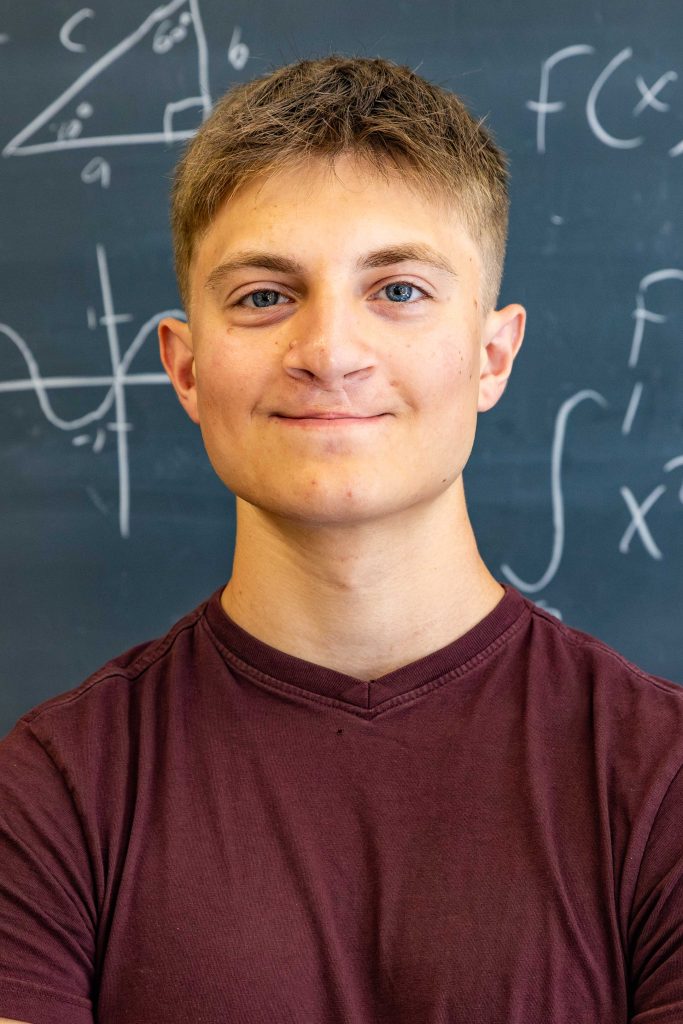
Hollenbeck said he wants to make math more engaging by emphasizing mental math, logic, reasoning, problem-solving and real-world applications.
His summer with Mizzou Academy gave him a new perspective on what happens before a student ever encounters a lesson.
“I didn’t realize what goes into formatting and accessibility,” Hollenbeck said. “It showed me there are a lot of things that go on behind the scenes that go into preparing a course.”
For an online mathematics course, those details can be extensive. Unlike a traditional classroom, where a teacher can easily write an equation on a board, online courses must account for how mathematical notation appears on a screen, how students using assistive technology access the content and how every element of a lesson works within the learning management system.
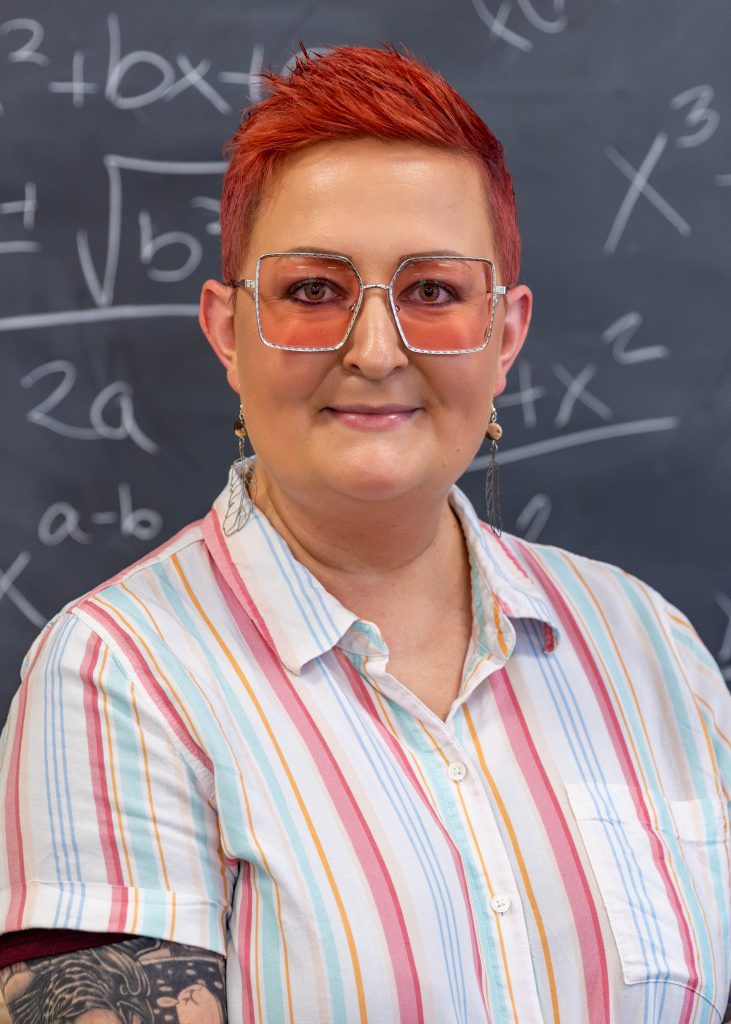
“Putting mathematics on a webpage is very different from designing mathematics for online learning,” said Beka Hanak, a mathematics education PhD student who has worked with Mizzou Academy since 2023. “In a classroom, a teacher can notice confusion and respond in the moment; online curriculum has to anticipate much more of that interaction in advance.”
Hanak began her work with Mizzou Academy by helping redesign and restructure its middle school mathematics curriculum. A licensed middle and high school mathematics teacher and former curriculum developer, she has since worked on middle school math courses, AI-assisted curriculum development and the learning management system supporting Mizzou Academy’s courses.
“A student’s experience is shaped by the curriculum, assessments, accessibility, course design, and the technology underneath all of it,” Hanak said.
One project had Hanak working with Mizzou Academy’s Angie Hammons, director of curriculum development and IT, and Brennan Ransdell, division chair for secondary mathematics, to leverage artificial intelligence to create embedded problem sets in existing Precalculus A and B curriculum into online-ready content.
The project changed how Hanak thinks about AI in education.
“The more important question is not simply, ‘Can AI do this?’ but ‘What should AI do, what should humans remain responsible for, and how can the strengths of each complement one another?’” she said.
For Hollenbeck, the experience reinforced the importance of designing lessons with individual students in mind — something he has learned through tutoring.

“When I am sitting next to a student, I have to be able to explain it in a way that the student I’m working with can understand it,” he said.
That same principle applies to online learning. Some students may respond well to video, while others may benefit from written explanations, examples or other approaches. Creating an online course means anticipating those different needs.
Kathryn Fishman-Weaver, executive director of Mizzou Academy and an associate teaching professor said working with students such as Hollenbeck and Hanak helps prepare them for the increasingly digital and global environments they will encounter as educators and researchers.
“Through their projects in mathematics education and technology infrastructure, Beka and Nathan have both broadened their views and experiences in secondary education,” she said. “They’ve also developed skills in global and digital competencies that will serve them in the classroom and in their research.”
The result is a two-way learning experience. Mizzou Academy students benefit from innovative, thoughtfully designed online courses, while the future educators helping create them gain practical experience that will shape how they teach, research and reimagine education.