Leadership in family science
By Emily Kebert
Photo by Morgan Solomon
For Sarah Mitchell, the study of families has always been about understanding people and the relationships that shape their lives.
Through her research, teaching and mentorship, Mitchell examines how identity, relationships and social experiences influence family life and well-being. Her work expands the field of family science by drawing attention to perspectives that have often been overlooked and by connecting scholarship with real-world practice.
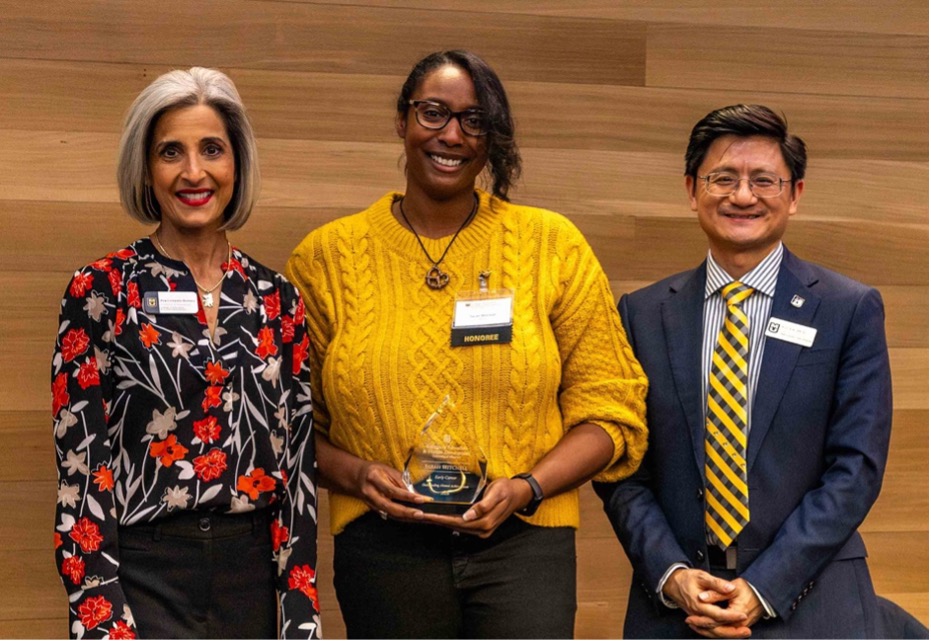
Mitchell, a three-time graduate of the University of Missouri, is the recipient of the College of Education & Human Development’s Early Career Alumni Achievement Award, which recognizes alumni who are making a significant impact early in their professional careers.
Today, she serves as an associate professor of Human Development and Family Studies at the University of Nevada, Reno, where her scholarship and mentorship continue to shape the next generation of family scientists.
A foundation at Mizzou
Mitchell first came to Mizzou as a student in the Honors College, earning a bachelor’s degree in psychology in 2008. Her interest in family relationships and human development led her to pursue graduate study in Human Development and Family Science (HDFS), where she earned a master’s degree in 2012 and a doctorate in 2019.
Her time at Mizzou played a defining role in shaping both her research interests and her approach to scholarship. The program’s emphasis on strong theory, careful research design and thoughtful engagement with families prepared her to ask complex questions and pursue meaningful answers.
Mentorship also played a central role in that experience. Faculty members encouraged Mitchell to explore new ideas, take on leadership opportunities and think deeply about the responsibility scholars have to the communities they study.
“Larry Ganong and Marilyn Coleman shaped how I think, how I write and how I show up as a scholar,” Mitchell said of two retired faculty members and former chairs of HDFS. “The work I do today still has their fingerprints on it.”
Research that centers families
Mitchell’s research explores how family relationships are shaped by social context and lived experience. Her work focuses on understanding the challenges and strengths families navigate while highlighting the ways research can inform practice and policy.
Across publications, conference presentations and collaborative projects, her scholarship contributes to a deeper understanding of family relationships and the systems that influence them.
At the same time, Mitchell places strong emphasis on mentorship and teaching. She has guided undergraduate and graduate students across disciplines, helping them develop research skills while also supporting their growth as scholars and professionals.
At the University of Nevada, Reno, Mitchell’s commitment to teaching and mentorship has earned recognition through the Judith S. Bible Teaching Excellence Award and the Outstanding Graduate Advisor Award.
Scholarship and mentorship
For Mitchell, scholarship and mentorship are closely connected.
“I believe strongly that academic work is most meaningful when it is both intellectually rigorous and deeply human,” she said. “Whether mentoring students, conducting research or serving my community, I try to create spaces where people feel both seen and challenged to grow.”
Her colleagues say that approach is reflected in every aspect of her work.
As one nominator wrote, Mitchell “represents the future of family science: a scholar who combines strong research with thoughtful mentorship and a deep commitment to the people her work serves.”
Continuing the work
Receiving the Early Career Alumni Achievement Award holds special meaning for Mitchell because of the role Mizzou played in shaping her path.
“To the faculty and students I worked alongside here at Mizzou, you remind me that good scholarship is never done solo,” she said. “I carry that into every project and every student relationship I have now.”
As her career continues to grow, Mitchell remains focused on advancing research, mentoring students and strengthening the field of family science—work rooted in the values she first developed at Mizzou.